
The gentle kick at the bottom of a bonnet roof looks lovely, but it slows rainwater down right where the roof is shallowest. If you want to understand how to fix bonnet roof leaks, focus on the line where the pitch changes and on the lower slope beneath it. That is where laps, pitch and timber problems usually show up.
This guide explains what a bonnet roof is, the faults that affect it most, the tools you need and each repair step in plain English. If water is already coming through a ceiling, read our guide on how to fix a leaking roof from the inside first, then come back here for the outside repair.
What is a bonnet roof?
A bonnet roof, also called a kicked-eaves or bellcast roof, is a hip roof whose lower part flattens out to a gentler pitch near the eaves. It often extends over a porch or veranda.
What goes wrong with a bonnet roof?
| Problem | Sign | Cause |
|---|---|---|
| Leak at the change of pitch | Damp along a straight line inside | Tiles not lapping correctly at the kick |
| Leaks on the lower slope | Damp near the eaves | Pitch too low for the tiles |
| Sagging eaves | Wavy eaves line | Rotten or loose sprocket timbers |
| Gutter overflow | Water dripping off the edge | Slow drainage off the shallow slope |
| Loose hip tiles | Gaps on corners | Failed mortar |
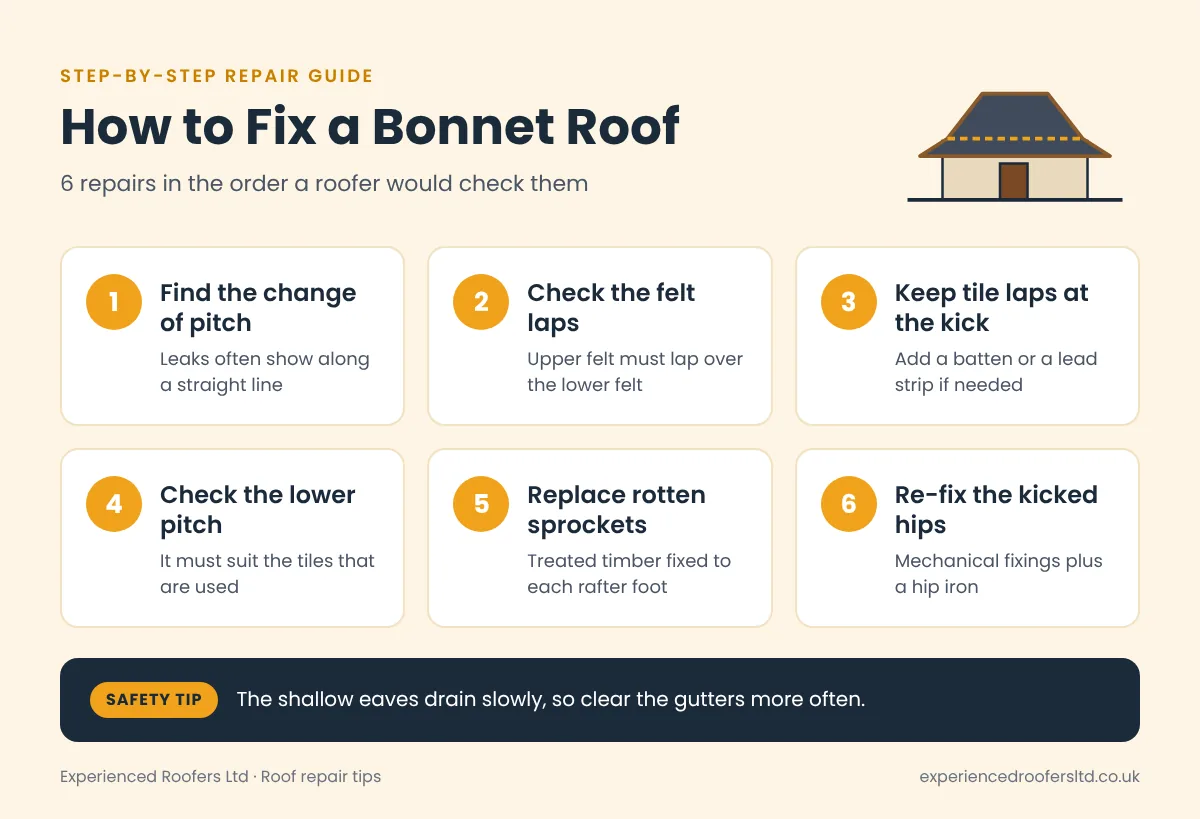
How do you fix a leak at the change of pitch?
- Lift the tiles in the two or three courses either side of the kick.
- Check the felt laps: the upper felt must lap over the lower, never under it.
- Make sure the tile laps are not reduced at the kick, and add an extra batten if needed.
- Fit a strip of lead or membrane under the kick if the tiles cannot lap fully.
- Refit the tiles and check they sit flat.
How do you fix the shallow lower slope?
Measure the pitch of the lower section and compare it with the minimum pitch for the tiles. If it is too shallow, rain blows under the tiles in wind. Options are a low-pitch tile designed for that angle, larger head laps, or a fully sealed membrane under the tiles.
How do you repair the sprocket timbers?
From inside the loft or soffit, check the short timbers fixed to each rafter foot that form the kick. Replace rotten sprockets with treated timber, fixed firmly to the rafter, then re-fix the fascia and gutter.
How do you fix the hips on a bonnet roof?
The hips also kick out at the bottom, so the hip tiles change angle. Re-bed or dry-fix the hip tiles, mechanically fix each one, and fit a hip iron at the bottom.
How do you maintain a bonnet roof?
- Clear the gutters often, as the shallow eaves drain slowly.
- Check the change-of-pitch line inside after heavy rain.
- Inspect the soffit for signs of rot.
- Keep moss off the lower slope.
When should a roofer fix a bonnet roof?
Repairs at the kick involve lifting several courses and checking laps and pitch, which needs experience. If the sprockets are rotten or the pitch is too low, get a roofer to assess it.
Conclusion: How to Fix Bonnet Roof Leaks the Right Way
To fix a bonnet roof, focus on the lower, shallower slope and the line where the pitch changes. Rain slows down on the flatter eave section, so tiles there need the right pitch and laps, and the joint at the change of pitch must be sealed. Also check the sprocket timbers that create the kick.
Key points to remember:
- A bonnet roof has a steep upper slope and a shallower kicked lower slope.
- The lower slope must still be steep enough for the tiles used.
- Leaks often show on a line where the pitch changes.
- Sprockets (the short timbers forming the kick) can rot at the eaves.
Now you know how to fix bonnet roof leaks in the right order. Work in dry, calm weather, follow the HSE’s advice on working at height, and stop if the timbers feel soft or the job is out of safe reach. For what to do while water is still coming in, see our main guide on how to fix a leaking roof from the inside.
Previous guide: How to fix a saltbox roof · Next guide: How to fix an M-shaped roof
Bonnet roof repair FAQs
What is a bellcast roof?
Bellcast is another name for a roof with kicked eaves, where the lower part flares out like the base of a bell.
Why does my roof leak along a straight line?
On a bonnet roof, that line is usually the change of pitch, where tile or felt laps have failed.
Are bonnet roofs harder to repair?
A little, because the angle change means tiles and hips need careful setting out.
More Roof Repair Guides by Roof Type
- How to fix a gable roof: verges, ridge and bargeboards
- How to fix a hip roof: hip tiles, hip irons and cut tiles
- How to fix a flat roof: felt, EPDM and GRP patches
- How to fix a mansard roof: the kerb, slates and dormers
- How to fix a gambrel roof: the break line and sagging
- How to fix a shed roof: patching and re-felting
- How to fix a butterfly roof: the central valley gutter
- How to fix a Dutch gable roof: the gablet, verge and hips
- How to fix a pyramid roof: the apex, finial and hips
- How to fix a skillion roof: abutment flashing and pitch
- How to fix a dormer roof: lead soakers, apron and window seals
- How to fix a saltbox roof: the long slope, gutter and ridge
- How to fix an M-shaped roof: the central valley and twin ridges
- How to fix a clerestory roof: window seals and abutments

Phillip Holland is the founder of Experienced Roofers Ltd, bringing 30 years of roofing and construction expertise to homeowners across Wiltshire. A certified roofer who has overseen hundreds of projects, Phillip writes to demystify roofing problems, covering everything from spotting early leak damage to choosing the right roofing material and knowing when it’s time to call a professional.