
An M-shaped roof is really two pitched roofs side by side, with a valley gutter tucked between them. When it leaks, water usually shows up in the middle of the top-floor ceiling. Learning how to fix M-shaped roof leaks means starting with that central valley, then checking both ridges and the outer slopes.
This guide explains what an M-shaped roof is, the faults that affect it most, the tools you need and each repair step in plain English. If water is already coming through a ceiling, read our guide on how to fix a leaking roof from the inside first, then come back here for the outside repair.
What is an M-shaped roof?
An M-shaped roof is a double-pitched roof: two gable roofs built side by side, so the end view looks like the letter M. The two inner slopes meet in a central valley that carries rainwater to the front or back of the building.
Where does an M-shaped roof leak?
| Area | Fault | Sign |
|---|---|---|
| Central valley | Blocked, split or worn lining | Damp in the middle of the top floor |
| Valley outlet | Blocked hopper or downpipe | Overflow at the end wall |
| Inner slope tiles | Slipped tiles near the valley | Damp along the valley line |
| Two ridges | Cracked mortar, loose tiles | Damp under either ridge |
| Gable ends | Loose verges | Damp on end walls |
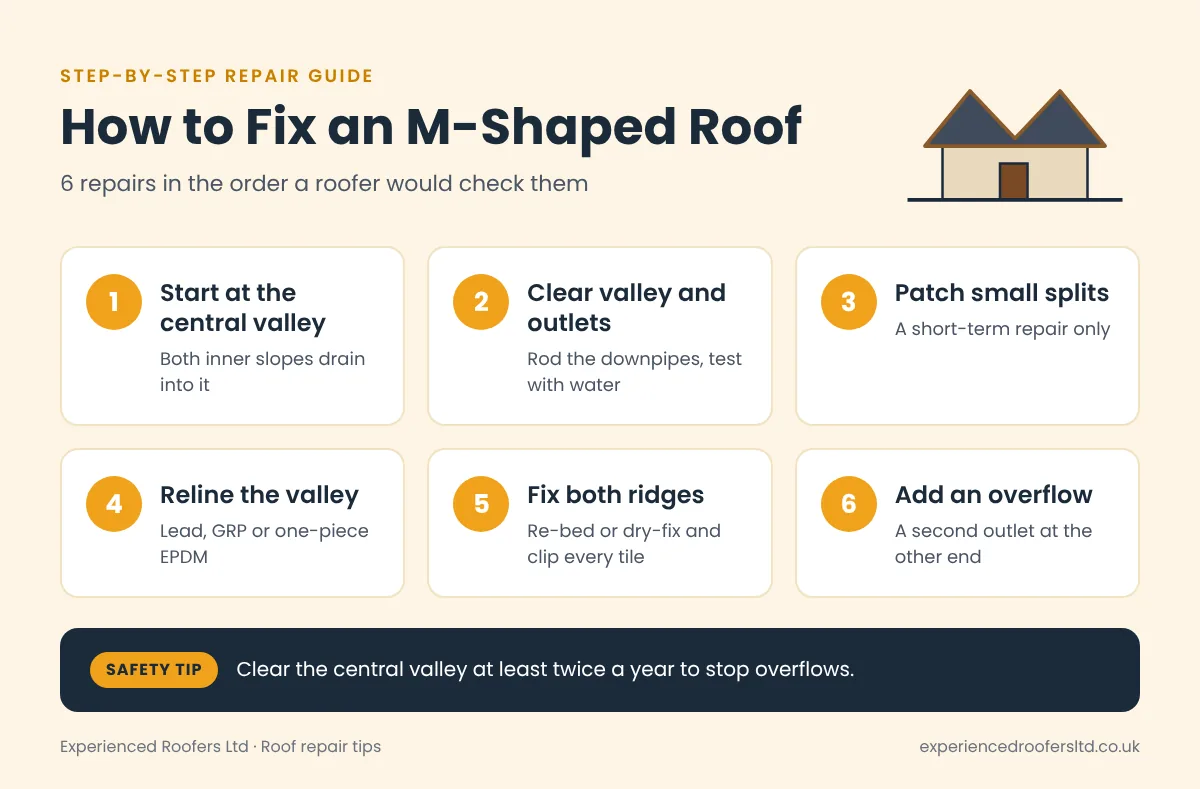
How do you clear an M-shaped roof valley?
- Access the valley safely from a scaffold or roof ladder.
- Remove leaves, moss and silt along its full length.
- Clear the outlet or hopper at the end and rod the downpipe.
- Pour water down the valley to check it drains to the outlet.
How do you repair the central valley?
Small splits in lead or membrane can be sealed short term with a repair patch. For a lasting fix:
- Lift the tiles along both sides of the valley.
- Remove the worn lining and check the valley boards.
- Replace any soft boards.
- Fit a new lining of lead (in short lapped lengths), GRP or a single sheet of EPDM.
- Make sure the lining turns up well under the tiles on both sides.
- Refit the tiles, leaving a clear channel down the middle.
How do you fix the ridges on an M-shaped roof?
Check both ridge lines for cracked mortar or loose tiles. Re-bed or dry-fix them, and fix each ridge tile mechanically as BS 5534 recommends. Seal the ridge ends at the gables.
How do you stop an M-shaped roof valley overflowing?
Fit a leaf guard at the outlet and consider a second overflow outlet at the other end. Keep trees cut back, and clear the valley at least twice a year.
How do you maintain an M-shaped roof?
- Clear the central valley and outlets every spring and autumn.
- Check the valley after storms for blown-in debris.
- Inspect both ridges once a year.
- Watch for damp in the middle of the top-floor ceilings.
Is it safe to fix an M-shaped roof yourself?
The valley is high and between two slopes, and relining it means lifting tiles on both sides. Proper access and lead skills are needed.
Conclusion: How to Fix M-shaped Roof Leaks the Right Way
To fix an M-shaped roof, start with the central valley between the two ridges, because both inner slopes drain into it. Clear it, check the outlet at each end, and repair or reline the valley if it is split or worn. Then check both ridges and the outer slopes for loose or slipped tiles.
Key points to remember:
- An M-shaped roof is two pitched roofs side by side with a valley between them.
- The central valley gutter is the main leak point.
- The valley needs a clear outlet or it will overflow into the building.
- There are two ridges to maintain instead of one.
Now you know how to fix M-shaped roof leaks in the right order. Work in dry, calm weather, follow the HSE’s advice on working at height, and stop if the timbers feel soft or the job is out of safe reach. For what to do while water is still coming in, see our main guide on how to fix a leaking roof from the inside.
Previous guide: How to fix a bonnet roof · Next guide: How to fix a clerestory roof
M-shaped roof repair FAQs
Is an M-shaped roof the same as a butterfly roof?
No. An M-shaped roof has two ridges with a valley between; a butterfly roof has no ridge and slopes inwards from both outer edges.
Why does my M-shaped roof leak in the middle?
The middle of the building sits under the central valley, so a blocked or failed valley usually causes it.
How long does a valley lining last?
Well-fitted lead can last for decades; EPDM and GRP linings are also long-lasting when installed correctly.
More Roof Repair Guides by Roof Type
- How to fix a gable roof: verges, ridge and bargeboards
- How to fix a hip roof: hip tiles, hip irons and cut tiles
- How to fix a flat roof: felt, EPDM and GRP patches
- How to fix a mansard roof: the kerb, slates and dormers
- How to fix a gambrel roof: the break line and sagging
- How to fix a shed roof: patching and re-felting
- How to fix a butterfly roof: the central valley gutter
- How to fix a Dutch gable roof: the gablet, verge and hips
- How to fix a pyramid roof: the apex, finial and hips
- How to fix a skillion roof: abutment flashing and pitch
- How to fix a dormer roof: lead soakers, apron and window seals
- How to fix a saltbox roof: the long slope, gutter and ridge
- How to fix a bonnet roof: the change of pitch and sprockets
- How to fix a clerestory roof: window seals and abutments

Phillip Holland is the founder of Experienced Roofers Ltd, bringing 30 years of roofing and construction expertise to homeowners across Wiltshire. A certified roofer who has overseen hundreds of projects, Phillip writes to demystify roofing problems, covering everything from spotting early leak damage to choosing the right roofing material and knowing when it’s time to call a professional.